
 |
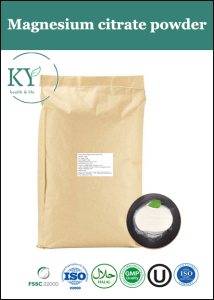
Material | Magnesium Hydrogen Citrate |
| CAS | 144-23-0 | |
| Compostion | 100% Magnesium Hydrogen Citrate | |
| Starting Material | Citric acid, Magnesium hydroxide | |
| Package | 25kg/bag | |
| Shelf Life | 2 Years | |
| Origin | China |
Magnesium Hydrogen Citrate is a specific acid salt of magnesium and citric acid. It is distinct from the more common trimagnesium citrate in its composition, structure, and physical properties, most notably its solubility.
1. Molecular Formula and Structure
Molecular Formula: MgC₆H₆O₇
-
-
This formula shows that one magnesium ion (Mg²⁺) is associated with one citrate molecule that retains two of its three original acidic hydrogen atoms (hence
H₆).
-
Structure:
-
-
The citrate anion (C₆H₅O₇³⁻) has three carboxylate groups (-COO⁻).
-
The other two carboxylate groups are likely protonated (in the form of -COOH) or associated with hydrogen ions, making the molecule more acidic.
-
2. Superior Solubility over Trimagnesium Dicitrate
A key advantage of magnesium hydrogen citrate is its significantly higher solubility in water compared to trimagnesium dicitrate.
-
Reason for Higher Solubility:
-
Magnesium hydrogen citrate has a lower magnesium-to-citrate ratio and a more acidic character. Its structure, with remaining free carboxylic acid groups, allows it to form stronger hydrogen bonds with water molecules. This greatly enhances its interaction with and dissolution in water.
-
In contrast, trimagnesium citrate (Mg₃(C₆H₅O₇)₂) is a neutral salt with a high magnesium-to-citrate ratio and a more complex, highly cross-linked crystalline structure. This makes it much less able to interact with water, resulting in very low solubility.
-
-
Practical Implication:
-
The high solubility of this material translates directly to higher bioavailability. As a supplement, the magnesium in this form is more readily dissolved in the digestive tract and is therefore easier for the body to absorb. This makes it a more efficient source of magnesium and contributes to its common use in laxative preparations, where its osmotic effect in the gut is key to its function.
-
3. Specification
| Material Name | Magnesium hydrogen citrate powder | ||
| Synonyms | Magnesium citrate dibasic | ||
| CAS No. | 144-23-0 | ||
| Chemical formula | MgC6H6O7 | ||
| Molecular Weight | 214.4 | ||
| Description | white to almost white, hygroscopic powder | ||
| According | |||
| Identification | Pass A, B | ||
| Magnesium (dry basis) | 8.0-8.8% | ||
| Loss on drying | ≤26.0% | ||
| Chloride | ≤0.05% | ||
| Sulfate (On SO4 base) | ≤0.2% | ||
| Limit of Calcium | ≤1.0% | ||
| Arsenic | ≤1 ppm | ||
| Heavy metals | ≤50 ppm | ||
| Iron | ≤200 ppm | ||
| Lead | ≤3 ppm | ||
| Cadmium | ≤1 ppm | ||
| Mercury | ≤1 ppm | ||
| pH (50mg/ml) | 3.0-4.0 | ||
Link: