
Magnesium citrate is a widely used magnesium supplement known for its high bioavailability. However, not all magnesium citrate is the same. Two common forms are magnesium citrate nonahydrate and magnesium citrate anhydrous. Understanding their differences is essential for manufacturers and formulators to choose the right ingredient for their applications.
1. Chemical Composition and Water Content
-
Magnesium Citrate Nonahydrate contains nine water molecules per magnesium citrate molecule. Its chemical formula is typically written as Mg₃(C₆H₅O₇)₂·9H₂O. The water content contributes to its crystalline structure and physical properties.
-
Magnesium Citrate Anhydrous has no water molecules in its structure. It is produced by removing the water of hydration through drying processes, resulting in a more concentrated form.
2. Key Properties Compared
| Property | Nonahydrate | Anhydrous |
|---|---|---|
| Water content | ≤29% | ≤2% |
| Magnesium content (by weight) | About 11% | About 15% |
| Appearance | White crystalline powder | White fine powder |
| Hygroscopicity | Low | High |
Due to its lower magnesium content per gram, the nonahydrate form requires larger dosages to deliver the same elemental magnesium compared to anhydrous.
3. Applications in Supplement Manufacturing
All forms are used in dietary supplements, but the choice depends on the manufacturing process and final product type.
-
Tablet Production
Kangyo provides DC (Direct Compression) granules (granular) specifically designed for tablet manufacturing. These granules ensure excellent flowability and compressibility, reducing issues like capping or sticking. Both nonahydrate and anhydrous forms can be adapted into DC granules, but anhydrous is often preferred for high-potency tablets due to its higher magnesium content. -
Powder Formulations
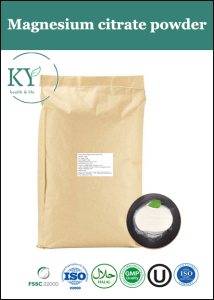
For powders, sachets, or bulk blends, magnesium citrate powder is available in both hydration states. Kangyo’s powder products are milled to precise particle sizes to achieve consistent blending and dissolution. -
Ultrafine powder
Kangyo also offers ultrafine powder for applications requiring rapid dispersion or smooth mouthfeel, such as chewable tablets or instant powders, gummy.
-
high-solubility powder
It engineered for liquid formulations or clear solutions, where fast and complete dissolution is critical.
4. Choosing the Right Form for Your Application
-
Use nonahydrate when you need a less hygroscopic material or when a milder processing condition is preferred.
-
Use anhydrous when you need higher magnesium concentration per tablet, reducing tablet size and number of excipients.
-
Use DC granules (available for both forms) for efficient, high-speed tablet compression.
-
Use ultrafine grade for improved mouthfeel in chewables or faster disintegration.
-
Use high-solubility grade for clear liquids, effervescent tablets, or gummies.
5. Why Kangyo?
Kangyo is a trusted supplier of food ingredients in China. The magnesium citrate product portfolio includes:
-
Magnesium citrate powder (nonahydrate and anhydrous)
-
DC granules for tablet compression
-
Ultrafine (extrafine) powder
-
High-solubility magnesium citrate
All products are manufactured under strict quality control to ensure consistent particle size, purity, and performance. Whether you are developing tablets, capsules, powders, or liquids, Kangyo offers a tailored solution for your formulation needs.
The choice depends on your target magnesium content, manufacturing process, and final product characteristics. With Kangyo’s diverse range—including powder, DC granules, ultrafine, and high-solubility options—you can achieve optimal results for any application. Contact Kangyo today to find the right magnesium citrate for your next product.
To view more about our products