
Calcium citrate malate (CCM) has become the preferred calcium source for formulators who need both bioavailability and formulation flexibility. Unlike calcium carbonate, CCM delivers absorbable calcium without demanding gastric acid or a mandatory meal. For brands developing bone health supplements, fortified beverages, or sensitive-population formulas, choosing the right calcium citrate malate supplier directly affects product performance and supply reliability.
Kangyo, a China-based ingredient manufacturer, supplies calcium citrate malate alongside a broad portfolio of calcium raw materials. The company exports to multiple countries and regions, serving supplement brands and food manufacturers who require consistent quality and technical documentation.
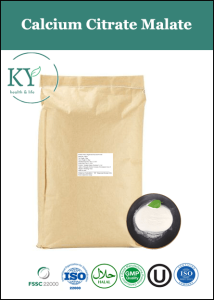
What Makes Calcium Citrate Malate Different
CCM is not a physical blend of calcium citrate and calcium malate. It is a compound salt with a distinct crystalline structure and higher aqueous solubility than either component alone . This structural difference matters in formulation: CCM dissolves sufficiently for beverage fortification, enabling 500 mg of elemental calcium (from approximately 2.1 g of CCM) to dissolve in 200 mL of water .
The calcium content of anhydrous CCM sits at roughly 23.7% . That is lower than calcium carbonate (about 40%) but meaningfully higher than calcium lactate (13%) or calcium gluconate (9%) . For formulators balancing pill size against deliverable calcium dose, CCM occupies a practical middle ground.
The Bioavailability Evidence
The strongest argument for CCM is human absorption data. In a randomized crossover study of 25 premenopausal women, CCM-fortified orange juice delivered 48% more absorbed calcium than a tricalcium phosphate/calcium lactate system. Absorbed calcium measured 148 mg for CCM versus 100 mg for the comparator (P<.001) .
Earlier research established that calcium from CCM was absorbed significantly better than from calcium carbonate or milk in human subjects . The European Food Safety Authority reviewed CCM in 2007 and concluded that calcium is bioavailable from this source, with no safety concern at estimated intake levels .
An important practical implication: CCM can be taken with or without food. Because it does not require meal-stimulated gastric acid for dissolution, it suits elderly users, individuals on proton-pump inhibitors, and anyone with reduced gastric acid secretion . This is a meaningful differentiator against calcium carbonate, which depends on acidification for absorption.
Formulation Advantages for Beverages and Supplements
CCM’s solubility profile makes it particularly suitable for liquid and effervescent applications. Calcium settling is a persistent problem in plant-based beverages, where unshaken product often contains less calcium than the label claims . CCM reduces this risk while avoiding the chalky mouthfeel associated with insoluble calcium salts.
The malate component also contributes a mild, fruit-like acidity that integrates well into juice systems and gummy matrices. For clean-label formulations, this can reduce the need for masking agents.
Kangyo supplies CCM in powder form suitable for:
-
Fortified juices and plant-based beverages
-
Effervescent tablets and powder sticks
-
Chewables and gummies
-
Capsules and tablets for bone health formulas
-
Prenatal and geriatric nutrition products
Why Source CCM from Kangyo
Kangyo operates as a multi-category calcium supplier, not a single-product trader. The company’s portfolio covers calcium citrate malate, calcium citrate, calcium malate, and other mineral salts, allowing customers to consolidate raw material sourcing. For brands developing combination formulas—CCM with vitamin D3, magnesium, or zinc—this simplifies supplier management and documentation.
The company exports to markets across Europe, North America, Southeast Asia, and the Middle East. Quality documentation, including certificates of analysis and regulatory support materials, is available for customer qualification. For formulators comparing calcium sources, Kangyo can provide samples and technical consultation on CCM’s behavior in specific matrices.
As a calcium citrate malate supplier based in China, Kangyo positions itself on consistency and export experience rather than the lowest price point. CCM commands a premium over calcium carbonate, and buyers should evaluate suppliers on bioavailability data, particle size consistency, and batch-to-batch solubility rather than cost alone .
Selection Checklist for CCM Buyers
When evaluating a calcium citrate malate supplier, request:
-
Bioavailability documentation referencing human studies, not just in vitro dissolution
-
Calcium content assay confirming the 23–24% range for anhydrous CCM
-
Solubility data at relevant pH ranges for your target application
-
Heavy metal and microbial testing against destination-market limits
-
Regulatory status confirmation for your specific market (CCM was authorized for food use in the EU in 2009 )
Kangyo provides these materials as part of the supplier qualification process. For brands ready to move from calcium carbonate to a more bioavailable source, or for manufacturers seeking a second CCM supplier for supply-chain resilience, the company offers sample quantities and technical data packages on request.
About Kangyo
Kangyo is a China-based manufacturer and exporter of mineral salts and nutritional ingredients, serving supplement and food brands across global markets. The company’s calcium portfolio includes calcium citrate malate, calcium citrate, calcium malate, and calcium carbonate. For inquiries, contact the Kangyo sales team for specifications, samples, and pricing.
Link:
Spec for calcium citrate malate
View more products of Kangyo