
When formulating dietary supplements, the physical form of your raw material is not just a detail — it is the foundation of your production efficiency and product quality. For manufacturers working with Calcium Citrate, a common question arises when sourcing from suppliers like Kangyo: “Both the fine powder and the DC (Direct Compression) granules can be used for tableting, but what is the actual difference?”
The short answer is yes, both can be used to press tablets. However, the user experience, machine wear, and final product quality differ significantly.
Kangyo offers Calcium Citrate Fine Powder as well as DC Granules (including both pure granules and DC 97 granules with starch binder) to meet diverse manufacturing needs. Here is a professional breakdown to help you make the right decision for your supplement line.
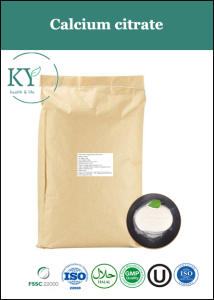
1. The Similarity: The Core Raw Material
First, the chemistry is consistent. Whether you choose powder or DC granules, Kangyo supplies high-purity Calcium Citrate that complies with international standards (USP, BP, EP, FCC). As a chelated organic calcium, it is known for its high bioavailability and gentle absorption on the stomach, making it suitable for all age groups.
The difference lies purely in physical engineering, not chemical composition.
2. The Differences: Functionality and Processing
Here is the detailed comparison of how Calcium Citrate Powder and DC Granules perform on a press:
| Feature | Calcium Citrate (Fine Powder) | Calcium Citrate (DC Granules) |
|---|---|---|
| Physical Form | Fine, flour-like dust (micronized) | Free-flowing, porous spherical particles |
| Flowability | Poor to Moderate. Tends to bridge or rat-hole in hoppers. | Excellent. Flows like sand, ensuring consistent die fill. |
| Compactibility | Poor. Prone to capping or lamination if compressed alone; requires external binders. | High. DC granules are engineered for superior binding. |
| Tablet Hardness | Low, prone to capping or lamination | High, compact core |
| Mouthfeel | Chalky/Sandy. Unprocessed powder feels gritty in chewables. | Smooth & Creamy. Granulation reduces grittiness significantly. |
| Disintegration | Slow, relies on dissolution | Good. Engineered for optimal disintegration. |
| Formulation Flexibility | High. You control all excipients. | Low to Medium. Granule formulation is pre-defined. |
| Ready-to-Use | No | Yes. Just add lubricant and flavor, then press. |
3. Which One Should You Choose?
Choose Calcium Citrate Fine Powder if:
- You are making capsules or sachets (where compaction is not required).
- You have a high-shear granulator and plan to wet granulate the material yourself to customize the formulation.
- You are making solutions or liquid suspensions where fine powder disperses instantly.
- You require a starch-free formulation.
Choose Calcium Citrate DC Granules if:
- You want a “ready-to-use” solution for direct compression — just add lubricant and flavor, then press immediately on a rotary press.
- You are making chewable tablets and want a smooth, non-gritty mouthfeel.
- You have faced capping, lamination, or low hardness issues with powder.
- You want to minimize external excipients and simplify your supply chain.
- You need reliable tablet hardness and fast disintegration without extensive formulation development.
4. Kangyo’s DC Granule Offerings
Kangyo provides two types of DC granules to accommodate different formulation preferences:
-
Pure Granules — 100% granulated Calcium Citrate without added binders.
-
DC 97 Granules — Formulated with a starch binder for enhanced compactibility and a creamier mouthfeel.
Both options deliver the excellent flowability and processability that DC granules are known for. The choice depends on your specific formulation goals and target product characteristics.
For more information on custom particle size distribution, specific starch content, or formulation assistance, contact the Kangyo technical team.
5. Why Kangyo Offers Both Powder and DC Granules
As a manufacturer adhering to GMP and FSSC 22000 standards, Kangyo recognizes that no two supplement brands have the same production line, formulation goals, or target audience.
-
Fine Powder offers flexibility for brands with wet granulation capabilities or those producing non-tablet formats (capsules, sachets, liquids).
-
DC Granules offer efficiency, consistency, and superior texture — especially crucial for high-speed tableting and premium organoleptic quality in chewable tablets.
Both products can be used for tableting.
However, if your goal is high-speed production, consistent tablet hardness, and a premium sensory experience — especially for chewable tablets — Kangyo’s DC Granules are the superior choice. They remove the friction from manufacturing and the grit from the mouthfeel.
For more information on custom particle size distribution, specific starch content, or formulation assistance, contact the Kangyo technical team.
Link:
Spec of Calcium citrate powder